
Twisting Elections

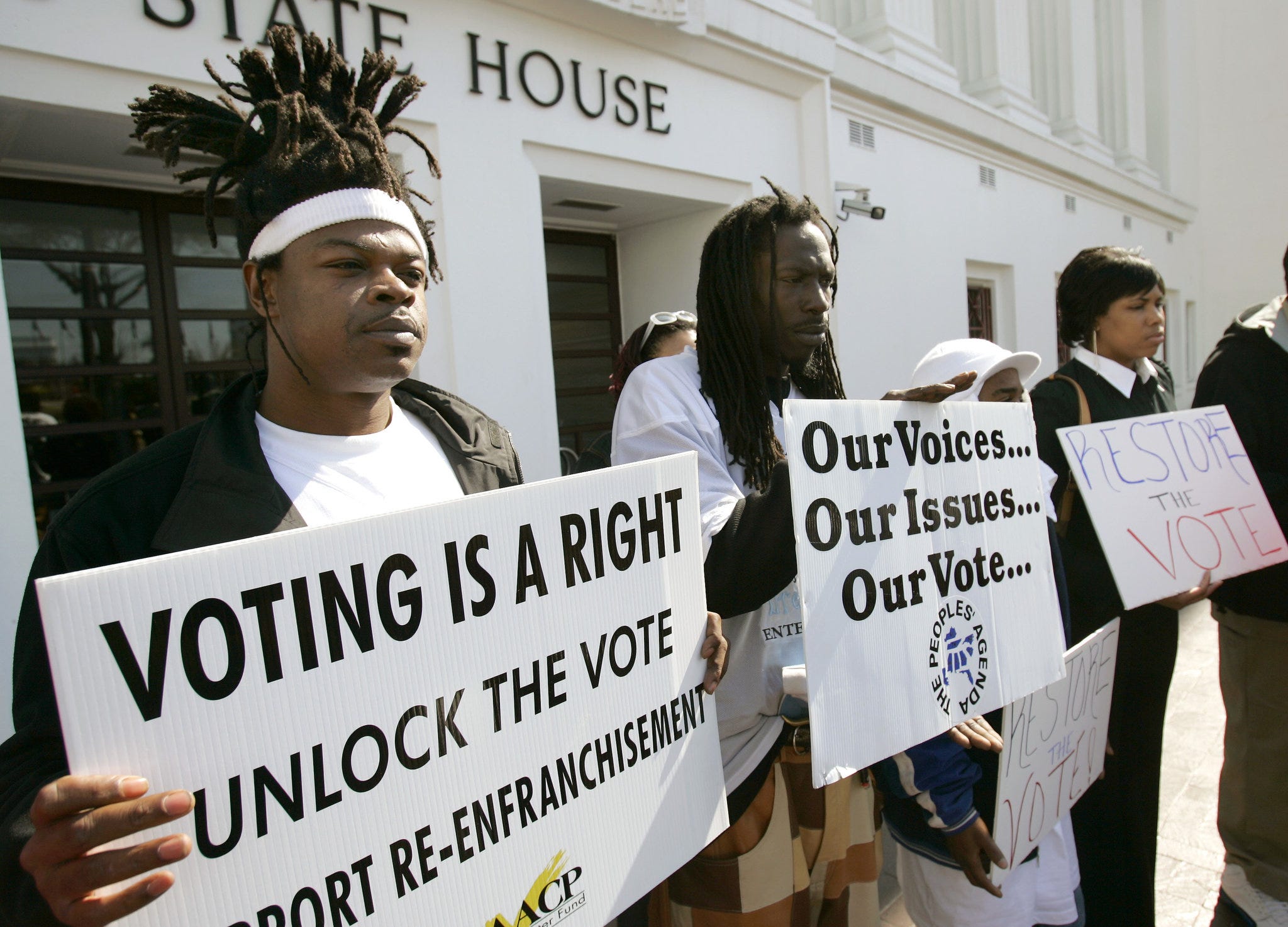
From a Google Image Search - The NYT
One of our favorite chants at some demonstrations is “one person, one vote.” Even as we chant it, we know that it is more aspirational than strictly true. For one thing we know that our votes are translated into numbers of electors apportioned to each state. We also know that states may determine whether to appoint all electors to vote for the winner in each state or apportion electors according to the breakdown of the vote. Maine and Nebraska are the only states that have taken advantage of this option, but even so they have rarely split the votes (each state did so only once).
For another thing we know that money can now officially (in a sense) “vote.” Of course, the wealthy and corporations always used money to influence, or perhaps, we could say, even buy votes. However, since Citizens United (2010) and ancillary decisions, it has been established by our Supreme Court that “corporations are people,” that they therefore have free speech. By logical extension this gives money the power of speech. These entities that already have outsized influence can contribute unlimited money to influence elections with ads and direct contributions.
Thus began the assault on the voting rights of “we the people” in the twenty-first century. It was another Supreme Court decision that began the current assault on voting by the Republican party in earnest. America never really mended after the Civil War. Reconstruction ended too soon because of the events that followed the assassination of President Abraham Lincoln. The Constitution was amended by the Thirteenth Amendment which said”
Section 1.
All persons born or naturalized in the United States, and subject to the jurisdiction thereof, are citizens of the United States and of the State wherein they reside. No State shall make or enforce any law which shall abridge the privileges or immunities of citizens of the United States; nor shall any State deprive any person of life, liberty, or property, without due process of law; nor deny to any person within its jurisdiction the equal protection of the laws.
Section 4.
The Congress shall have the power to enforce, by appropriate legislation, the provisions of this article.
Despite this amendment history tells us that freed slaves who tried to vote or participate in government were terrorized by groups of local white officials or formal groups like the KKK. We know that these angry citizens, intent on preventing black citizens from voting, even stole their land and killed them. Laws were passed to keep federal soldiers out of Southern states based on states’ rights arguments, so local sheriffs had the power to allow white citizens to defy the new voting laws. Reconstruction ended too soon to protect black voters in the South from disenfranchisement and worse.
The violence of the post-Civil War period gave way to the subtle humiliations of the Jim Crow South where white citizens embraced “separate but equal” as if such a situation could exist. Black folks who wanted to vote now faced poll tests and literacy tests or any test officials could dream up that black people could not pass. If you couldn’t pass, you couldn’t vote. Many gave up on voting, many held on through all the tricks designed to short circuit the Thirteenth Amendment.
After marches and fires hoses, beat downs and deaths the Voting Rights Act was finally passed in 1965 under LBJ. It put some states that were guilty of egregious use of local laws to bypass the Thirteenth Amendment in “preclearance.” Before they could make voting revisions the changes they made to voting had to be cleared with a higher authority. In 2013, in the Shelby v Holder decision of the Supreme Court, this preclearance section was excised from the Voting Rights Act. Proving that such voting protections had been removed too early, just as removing federal troops from the South during Reconstruction had been too early, states began passing voting restrictions, not only the states the law had suppressed for violating the Thirteenth Amendment, but all the states we now call red states, states that make us feel we could be headed for a second Civil War.
Evangelicals (the church), allies of Republicans have researched voting data down to the granular level, house by house. Evangelicals don’t pay taxes. They have 501c exemptions, but they lose their tax-exempt status if they set out to influence politics. The only oversight on this is through the IRS. Republicans ‘screamed bloody murder’ in Congress when IRS agents tried to enforce violations of the exempt status by the church on behalf of the Republicans. It worked; the IRS backed off.
Armed with such a detailed data base, Republicans engaged in some extreme gerrymandering. The new districts they drew seemed racist, but Republicans denied this. The problem was that many locations in the US are still somewhat segregated, and many Black Americans are known to vote as Democrats. Since it was easy to separate out Black Dems in these neighborhoods, it was even easier to draw district lines that would allow Republicans to attack Black voters and yet insist they were actually attacking Democrats who had rigged the vote. White neighborhoods were harder, because the parties were mixed in those areas, but given data that was so specific there were some hinky districts drawn throughout red states.
Extreme gerrymandering allowed Republicans to target Black neighborhoods that had worked for years on ways to get out the vote. Republicans changed the number and locations of polling places. They chose locations that were hard to reach by public transportation. They cut back on the number of voting days. This meant longer lines at fewer polling places. They worked to undermine Souls to the Polls arrangements which took Black worshippers to the polls after church services. They insisted on purging voter rolls. In other words, as Democrats tried to enfranchise voters, Republicans tried to disenfranchise Democratic Party voters. Sometimes the courts stopped these activities, but often they were allowed to stand. There is no Constitutional referee who cries foul whenever a Constitutional guardrail gets a ding. Attacks on voting became commonplace.
The Democrats passed the John Lewis Voting Rights Act in the House but the two Democrats who withhold their votes on Democrat’s bills made it impossible to restore the Voting Rights Act to full effectiveness since the filibuster was still in place for this legislation. If Democrats win both houses of Congress in the 2022 midterms, we may get back important voter protections.
Trump’s attacks on voting have been far bolder than those of the Republican attacks in the red states. Trump does not mind lying, so he claimed, with no evidence whatsoever, that there was massive voter fraud being perpetrated by the Democrats. COVID brought health protections to voting like mail-in voting and ballot drop boxes, and expansions of absentee voting, extra early voting days and a greater use of voting machines. Republicans and Trump went ballistic. In red states many of these voting adjustments were outlawed amid cries of fraud and fake votes, and stolen elections.
When it was clear to most of us that Trump had lost the 2020 election, he claimed that Biden and the Dems stole the election. He popularized his “Stop the Steal” meme, also his “Big Lie” meme and his followers, oops, voters insisted on recounts, filed lawsuits, told us that voting machines had been hacked by other nations, or attacked by space lasers wielded by Jewish people (that couldn’t be what they said). But he could not help himself. Trump is not bound by the Constitution or by laws. If you can come up with a creative way to skirt a law you don’t like, then everyone should admire you. He went along with John Eastman’s plan to have fake slates of electors in seven states. The National Archives caught the fakes, but the electoral college is now in play, the damage is done. Newly empowered states have discovered that they have some leeway in terms of how they count and certify electoral votes so plans are being made for what might work to keep a Republican in the executive branch by manipulating electoral college votes.
When Donald Trump went to the Secretary of State in Georgia to ask him to find 11, 780 votes, there was suddenly a eureka moment among Republicans. Making sure Republicans were elected to Secretary of State positions in as many states as possible where they were allowed to certify vote counts and strip election rolls was an untried strategy, not yet declared unconstitutional, a strategy that just might tip the scales of presidential elections to the right in many states. Unfortunately for American voters who might expect courts to overturn such quasi-legal shenanigans, the Supreme Court just happens to lean dangerously right and will most likely leave election procedures up to the states.
Tonight, the FBI raided Mar-a-Lago for reasons we can only guess at so far. Will the DOJ restore integrity to our elections? Probably not. Voting rights were given to the states, although states cannot violate federal laws. Who will enforce the laws which Republicans say are not even being broken? If we don’t win the legislative branch in 2022, will we be able to win the popular vote in any future presidential elections, or the electoral vote. Will our belief in free and fair elections be restored and if so, how?
It has been tough to watch this all happen, to raise our pointer finger in the air and say, “can they do that.” It has been even tougher to see how often it turns out they can do that and more. At its base this is about twisting the traditional interpretations of the Constitution and then allowing some citizens to simply trash our laws. If we get the chance when the Democrats are in power, we might want to tweak our Constitution to make sure the interpretations that we rely on historically and traditionally prevail.
Subscribe to get this newsletter in your inbox.